Fair warning: this is a totally random blog post about a crazy topic of purely personal interest. Any one who's ever visited my home knows I'm an avid reader. I love falling into other worlds, other lives through the pages of a book, and I've had a long-time love affair with the English language. Most of all, I love beautifully written fiction where the language is part of the feast. Over the past few years, I've noticed a disturbing trend. The wonderful, eclectic, beautifully irregular past tenses of a number of verbs are disappearing from mainstream publishing! Reading, "I hanged my hat on the hook by the door" makes me cringe. It's just wrong: wrong, wrong, wrong!
In recent books, characters have hanged instead of hung, dreamed instead of dreamt, beholded instead of beheld, weaved instead of wove. Beholded? Weaved? Really? Mrs Gates, my fifth grade teacher, would have made me rewrite my paper if I'd tried such a thing in her class!
Interestingly, Blogger's spell check believes dreamed is correct, but cautions against beholded and dreamt (it has no opinion on weaved vs. wove). The proper past tense of dream does depend upon context - 'I dreamt a lovely dream last night while sleeping', but 'dreamed of being a ballerina as a child'. The lovely textual and contextual nuances of irregular verbs! I find myself wondering, is this breakdown in the beauty and intricacy of the English language due to the tyranny of faulty spellcheck programs? Of programers who didn't pay quite enough attention to their English teachers way back when?
I decided to try to find an answer and did a search "why are irregular verb past tenses disappearing?" I found several blog references to a Harvard study trying to mathematically model the regularization of irregular verbs based upon their frequency of usage. Basically, the more often a particular verb is used, especially in its past tense, the less likely it is to be regularized.
That said, the study apparently gave 'be/was' and 'have/had' half-lives of 38,000 years! Meanwhile they gave less commonly used irregular verbs, such as 'dive/dove' a half-life of 700 years. What the blog post doesn't say is when the count started, because I hate to say it, but I've seen 'dived' in at least one of the books I've read recently (and Blogger's spell check accepted it, even if Mrs. Gates wouldn't have). I wonder if the study looked at the potential for incompletely designed spell checks to regularize irregular verbs more quickly? Also, I wasn't able to find a link to the original study, so I can't say that I've actually read it myself.
So I wonder, am I the only one who 'corrects' the past tense of irregular verbs as she reads? I find I enjoy my reading far more if I substitute my favorite irregular tenses for the regularized versions appearing on the page.
While 'researching' this topic over the weekend, I did find a wonderful list of English Irregular Verbs. Don't worry if you don't see your favorite irregular verb on the list. While this is the most comprehensive list I've found, it seems that none of the lists are truly complete. If you look at multiple lists of irregular verbs, you'll likely find yours among them.
Showing posts with label writing. Show all posts
Showing posts with label writing. Show all posts
Monday, June 29, 2015


Wednesday, June 3, 2015
Lessons Learned: Scrivener Writing Software
Every craftsperson knows that the right tools make the job simpler and easier. This week, I thought I’d share a review of one of my hands-down favorite pieces of software. It’s called Scrivener, and it’s designed to make it easier for authors to put their manuscripts together. In truth, it’s great for any large writing project with lots of ‘moving’ parts.
Why do I love Scrivener?
1) It makes it so much easier to organize your writing.
To organize your document using Word (or other traditional word-processors), you might create separate folders for each chapter, and then separate documents for each section in the chapters. To edit your project, you would need to find and open each individual file. This can mean lots of open files. And what if you want to see how one section flows into the next. Do you copy and paste both files into a separate document? Then what happens when you need to do more editing; which do you edit, the combined document or the individual files? Nightmare!
Scrivener organizes all of these 'files' within one Binder document. Here's a screenshot from an early version of my Scrivener file for Explorations in Freeform Peyote Beading.
The Binder window on the left gives a quick overview all my documents 'files' and 'folders'. I can click on any folder to see all of its files. Click on a file and it shows up in the larger window to the right. And if I want to see how one file flows into another?
I simply select multiple files from the binder at left to view them in the right window. A horizontal line shows the transition from one section to the next. You can see this in the screenshot above. (I added the red annotations in Photoshop).
Need to rearrange sections? It's as easy as simply dragging and dropping the file or folder names in the binder view at left.
2. Scrivener allows you to view two sections side by side.
This is so useful for editing!
3. Fantastic Tools for Printing and Compilation
When you are ready to 'print' you can compile and export the entire draft into a single Word document. Scrivener provides a number of tools to help you easily format that document. Checkboxes allow you to quickly select which files you wish to include when you compile your document.
This is particularly useful for for fiction or novel-style books. Since all of my page layout was in InDesign, I couldn't take advantage of the compile feature for the print copy of my book. But I did use this to create separate files for the ebook versions.
4. You can store research inside your Scrivener document

Scrivener allows you to store and organize your background research, documents and even whole web pages into a separate section. Amongst other things, I used the research section to store all of the text I'd received from my contributing artists, and copies of older blog posts that related to the book. Having this information easily accessible and organized made life so much easier!
The research doesn't compile with the rest of the draft, but remains with the Scrivener file.
5. At $45, it's Not Terribly Expensive
Literature and Latte (the company that produces Scrivener) offers a free 30 day trial for both Windows and Mac. If you fall in love with the software during the trial, its only $45. Compared to the other software I use, this is such a good price! (I don't have any affiliation with Scrivener, or Litterature and Latte except as a very happy customer).
In this review I've just barely touched on the power and capabilities of Scrivener. My goal was to simply highlight some of their most basic and powerful features. One of the other things I love about Scrivener is their in-depth (and FREE) instructional videos and tutorials that will quickly introduce you to so many more possibilities.
While it's designed for writers, I've used Scrivener for all sorts of things, including storing research for upcoming trips because it's so easy to organize and access information.
Why do I love Scrivener?
1) It makes it so much easier to organize your writing.
To organize your document using Word (or other traditional word-processors), you might create separate folders for each chapter, and then separate documents for each section in the chapters. To edit your project, you would need to find and open each individual file. This can mean lots of open files. And what if you want to see how one section flows into the next. Do you copy and paste both files into a separate document? Then what happens when you need to do more editing; which do you edit, the combined document or the individual files? Nightmare!
Scrivener organizes all of these 'files' within one Binder document. Here's a screenshot from an early version of my Scrivener file for Explorations in Freeform Peyote Beading.
 |
| Scrivener file for Explorations, with my original outline in the right window |
 |
| Screenshot from early in the project |
I simply select multiple files from the binder at left to view them in the right window. A horizontal line shows the transition from one section to the next. You can see this in the screenshot above. (I added the red annotations in Photoshop).
Need to rearrange sections? It's as easy as simply dragging and dropping the file or folder names in the binder view at left.
2. Scrivener allows you to view two sections side by side.
 |
| Scrivener allows you to view (and edit) two documents side-by-side |
3. Fantastic Tools for Printing and Compilation
When you are ready to 'print' you can compile and export the entire draft into a single Word document. Scrivener provides a number of tools to help you easily format that document. Checkboxes allow you to quickly select which files you wish to include when you compile your document.
This is particularly useful for for fiction or novel-style books. Since all of my page layout was in InDesign, I couldn't take advantage of the compile feature for the print copy of my book. But I did use this to create separate files for the ebook versions.
4. You can store research inside your Scrivener document

Scrivener allows you to store and organize your background research, documents and even whole web pages into a separate section. Amongst other things, I used the research section to store all of the text I'd received from my contributing artists, and copies of older blog posts that related to the book. Having this information easily accessible and organized made life so much easier!
The research doesn't compile with the rest of the draft, but remains with the Scrivener file.
5. At $45, it's Not Terribly Expensive
Literature and Latte (the company that produces Scrivener) offers a free 30 day trial for both Windows and Mac. If you fall in love with the software during the trial, its only $45. Compared to the other software I use, this is such a good price! (I don't have any affiliation with Scrivener, or Litterature and Latte except as a very happy customer).
In this review I've just barely touched on the power and capabilities of Scrivener. My goal was to simply highlight some of their most basic and powerful features. One of the other things I love about Scrivener is their in-depth (and FREE) instructional videos and tutorials that will quickly introduce you to so many more possibilities.
While it's designed for writers, I've used Scrivener for all sorts of things, including storing research for upcoming trips because it's so easy to organize and access information.
Thursday, May 14, 2015
Lessons Learned: Brainstorming and Outlines
I’m a little behind on everything right now. Last week I took a nosedive down my basement stairs and am still dealing with the repercussions. Teach me to try to do laundry!
This week, while waiting to determine if I need surgery on my broken foot, my thoughts keep turning to the importance of planning and organization. Outlining is the first, and one of the most important steps in developing a manuscript. Outlines help you define both the scope of work (which can also be summarized as your mission statement) and the breadth that you wish to cover. If you hope to approach a traditional publisher with your book idea, most will expect to see a polished outline.
Start by giving yourself a one-sentence mission statement outlining your goal. Then brainstorm, writing down everything you think you might want to include. You can do this in as much or as little detail as you please. Once you have your ideas down where you can see them, look for common patterns and themes. Does one idea build upon another? Treat your notes as pieces of an ever-expanding puzzle and move things around until they 'fit'. Your goal is to start sorting like with like to see how the pieces might all work together as a future whole.
My first mission statement for Explorations went something like this: “I want to showcase the breadth of what can be done with freeform peyote beading”. Pretty basic and far too open-ended, but it was a place to start. From there, I asked myself, what could that look like? My earliest outline only had a few points:
- Showcase the breadth of what might be done with Freeform Peyote Beading
- Basic to advanced techniques
- More in-depth primer to the creation process
- New projects
- More projects
- Not all jewelry
- Include works by other artists
My next goal was to fill things in the who, what, how, why, where and when. What techniques did I want to include, what did people need to be successful with the stitch, what types of projects, what work did I already have completed, what would I need to create, how would other artists and their work fit into the overall theme of the book? As I answered these questions, I arranged and rearranged the pieces until they started to form an overall picture. Some bullet points translated into chapters and sections of my manuscript. Others simply helped illuminate or better define the overall project.
My Four Rules of Outlines:
I. Outlines can be as simple or as complex as you desire. In the early stages of my book planning, I had very clear ideas of what I wanted to include in some areas. I made extensive notes as ideas came to me, including full paragraphs where necessary. It’s easy to forget things over the weeks, months and even years it takes to turn an idea into a finished book. If you think it might possibly be important later, write it down somewhere that it’s easy to find (so you don’t kick yourself later as you wrack your brain trying to remember that great idea you once had!)II. Outlines are never set in stone. Consider your outline a living document that will continue to change and evolve along with you and your manuscript.
I originally divided Explorations into five chapters with these headings:
- Getting Started
- Starting Small - Test Subjects & Little Beauties
- Bracelets and Cuffs
- Designing Larger Jewelry Projects
- Beyond Jewelry - Beaded Forms and Freeform Sculptures
Rather than dividing my book solely by project types, it’s organized more by building skills and how I thought about the creation process surrounding each item. Smaller projects like rings require significantly less planning and forethought than a freeform collar or beaded bottle. My final outline doesn’t look that different, but represents a shift in my thought process.
III. Outlines keep you focused. It’s surprisingly easy to get lost and wander off on random tangents when working on a long project. The ‘wouldn’t it be cool to include X’ factor. I use my outline to keep me focused by periodically pausing to see how and where my current work fits into the overall whole. If it doesn’t fit in my current outline, then I force myself to pause and ask if truly fits into my current manuscript, or if it should be set aside for a future project.
IV. Outlines help you track your progress. I’ll talk about developing your production timeline in more detail in a later post, but your outline is an excellent way to track how well you are progressing towards your goal.
As an example, say you’ve given yourself a twelve-month timeline to develop your manuscript. Let’s also say your outline is divided into five chapters. Here’s a sample timeline: one month for outlining/gathering data, and building your style-guides and templates; two months per chapter (5 chapters x 2 months = 10 months); and another month for proofing at the end. This is a tight production schedule, but it shows how the outline might be divided into a timeline.
In Summary
Outlines are living documents, not stone tablets. Whether simple or complex, their role is to act as goal posts and guides. If you've used outlines - what other ways have they helped you?While you work on your outline, you should also brainstorm ideas about the overall look and feel of your finished book, things you need to learn, and resources you could potentially tap to help you along the way. In my next few posts, I’ll talk more about these topics, including how I collected and organized my data for ease of use, setting up a more concrete timeline, and establishing style-guides for my finished book.
Thursday, February 6, 2014
Entering the Home Stretch
 |
| my Kickstarter Campaign as of February 6, 2014 |
Explorations will be a companion book to Freeform Peyote Beading, with new projects, new photographs, more and expanded beading diagrams covering more techniques, works by other artists and so much more.
Without the support of the Kickstarter, I still hope to write and publish Explorations. However, I fear its publication date may slip into 2015 as I will need to focus more of my time on activities that can help me cover expenses in 2014. I may also need to scale back on the scope of the project.
And on a totally personal note - writing is lonely. Knowing I have backers and people who want the project to succeed makes it less so. Instead of writing for a nameless, faceless audience, I will be writing for you - my Kickstarter supporters - as representatives of my larger audience.
Interested in becoming a part of that community and helping to insure that Explorations in Freeform Peyote Beading: Designing Original Art Jewelry and Beyond is published in time for Christmas 2014?
Spread the word by sharing the link to your Facebook wall. And if you're feeling generous, consider becoming an official backer of the project as well. You will have my personal thanks, a chance to pre-order copies of the book along with other special incentives and the knowledge that you helped a new beading book see the light of day.
Wednesday, January 15, 2014
Three, Two, One..... Launch

I've just launched my Kickstarter campaign for my next book, Explorations in Freeform Peyote Beading!
For those of you not familiar with Kickstarter, it's a form of crowd funding, connecting people with ideas with people who like those ideas enough to want to help make them happen. Kickstarter provides the basic tools, framework and online venue for the fundraising. The person with the idea takes it from there, reaching out to the world and saying "wouldn't it be cool if...". If she's lucky and really does have a great idea, the community and the world agrees, her campaign is funded, and she gets to work turning her idea into something real.
My idea: a new book entitled Explorations in Freeform Peyote Beading: Designing Original Art Jewelry and Beyond.
Reaching out to the World: This will be my second book on freeform peyote beading. Why have I decided to crowd fund this book, when I've self-funded both of my previous endeavors? The answer is simple - I don't want to compromise this time around. With Freeform Peyote Beading, I had to make some really hard choices in order to get it to publication. Decisions that meant information was left on the cutting floor because I simply couldn't afford to include them based on the additional time it would take to flesh them out.
I am still so proud of Freeform Peyote Beading - I stayed true to the core of the idea of what I wanted to present and I still believe it's an excellent introduction to freeform peyote beading.
With your support, Explorations can go the next step, continuing to bring this compelling, fascinating and challenging medium front and center. I may be the one writing and producing this book, but the truth is, it's not my book, but yours. I'm writing it for you and others like you who are interested in the same crazy beading that I am. So we can all create our own wonderfully original freeform designs.
Curious what I have planned? Wander on over to Kickstarter and check it out! You can even watch a little video where you'll see (and hear) me talk about the project. No worries about me abandoning writing for a film career though - I'm definitely a much better writer and author than I am videographer!
And if you like my ideas, please consider becoming a part of this project. I'd love to share this process of creation with you, and give you the tools to make your creative visions a reality.
Wednesday, January 1, 2014
New Year's Plans - a New Take on Freeform Peyote Beading
It's time to write the sequel to Freeform Peyote Beading!
My first book, Freeform Peyote Beading was totally a labor of love, born out of the belief that there must be others, somewhere, interested in the same crazy beading that I was. When I began that project there were no other books out in the field. Writing Freeform Peyote Beading I worked in largely uncharted territory, deciding what were the most essential elements necessary to be successful in this medium. I know there have been comments that my book could have been more. I have to agree - even then there was so much more I wanted to add. But in the interest of actually completing the project, I decided it was 'enough to be getting on with' as one of my friends would say.
In the past four years, my comfort and skills with the entire writing/editing and publishing process have grown tremendously. Better yet, I'm now part of a community of individuals from around the world interested in beadweaving in general and freeform beading in specific. And I know I'm not totally bonkers thinking that someone, somewhere might also be interested in my finished book.
So, after much thinking and plotting and planning through the second half of last year, I decided that 2014 is the time to create a new and improved version of Freeform Peyote Beading. I committed to that first project on January 1 of 2010, so it seems only fitting that I announce my intentions to create it's sequel here on my blog on the first day of 2014. Some of you may have seen my comment in the Freeform Peyote Beading group, but here's the formal (at least as formal as I tend to get) announcement:
The new book will be:
Larger and Longer The new book will be a full 8 1/2 x 11” paperback topping out at 150 pages - nearly twice the length of my original!
Full-bleed photography The full-color interior layout will include full-bleed photographs allowing me to expand the images all the way to the edges of the page.
More Designs, More Artwork, New Projects Most of the additional pages will be devoted to more and expanded beading examples and more in-depth tutorials with new designs.
Works by Other Artists I am in awe of the wonderfully vibrant community of artists working in this medium and hope to include and promote other artists through the medium of my book. As such, I am and will be actively soliciting participation through a Call for Artists. While I plan to post a Call for Artists here on my blog, let me know if you’d like to receive an email notification when it goes live.
Not Just Jewelry I'm adding a completely new chapter entitled “Beyond Jewelry” which will focus on freeform beading as a sculptural medium, including beading over ready made forms such as glass bottles and free-standing sculptures.
Index Amongst other things, I'm currently at work developing a list of keywords and phrases for a comprehensive index to make finding information even easier.
Digital Publishing I am also hoping to publish in both Kindle and PDF digital versions as well.
Expected publication date: December 2014. My plan is to have it available on Amazon by or before December 1st.
It's a long journey between here and there, with many, many steps. To help guide me on my way, I have my detailed outline along with my somewhat daunting production plan with deadlines for each element of writing, beading, photography, illustration, editing, page layout and more. And I'm ready to start. Excited, a little scared, part of me wondering what in the world I'm doing, but excited to dig in.
Is there something in particular you'd really love to see in the book? Now's the time to let me know! I'd love to hear your suggestions.
On January 15th, I'll be launching a Kickstarter campaign to continue building a community of supporters and to help me fund this project. In a project of this scale, community is so important. I want to continue to show the world what Freeform Peyote is all about and share some of the best and brightest from our community in the pages of my book. It will also be great to have that financial support while I work on a project of this size.
With this great new book project and my first Kickstarter, 2014 looks like it will be a fantastic year and here's wishing that yours will be just as wonderful!
Happy New Year!
My first book, Freeform Peyote Beading was totally a labor of love, born out of the belief that there must be others, somewhere, interested in the same crazy beading that I was. When I began that project there were no other books out in the field. Writing Freeform Peyote Beading I worked in largely uncharted territory, deciding what were the most essential elements necessary to be successful in this medium. I know there have been comments that my book could have been more. I have to agree - even then there was so much more I wanted to add. But in the interest of actually completing the project, I decided it was 'enough to be getting on with' as one of my friends would say.
In the past four years, my comfort and skills with the entire writing/editing and publishing process have grown tremendously. Better yet, I'm now part of a community of individuals from around the world interested in beadweaving in general and freeform beading in specific. And I know I'm not totally bonkers thinking that someone, somewhere might also be interested in my finished book.
So, after much thinking and plotting and planning through the second half of last year, I decided that 2014 is the time to create a new and improved version of Freeform Peyote Beading. I committed to that first project on January 1 of 2010, so it seems only fitting that I announce my intentions to create it's sequel here on my blog on the first day of 2014. Some of you may have seen my comment in the Freeform Peyote Beading group, but here's the formal (at least as formal as I tend to get) announcement:
The new book will be:
Larger and Longer The new book will be a full 8 1/2 x 11” paperback topping out at 150 pages - nearly twice the length of my original!
Full-bleed photography The full-color interior layout will include full-bleed photographs allowing me to expand the images all the way to the edges of the page.
More Designs, More Artwork, New Projects Most of the additional pages will be devoted to more and expanded beading examples and more in-depth tutorials with new designs.
Works by Other Artists I am in awe of the wonderfully vibrant community of artists working in this medium and hope to include and promote other artists through the medium of my book. As such, I am and will be actively soliciting participation through a Call for Artists. While I plan to post a Call for Artists here on my blog, let me know if you’d like to receive an email notification when it goes live.
Not Just Jewelry I'm adding a completely new chapter entitled “Beyond Jewelry” which will focus on freeform beading as a sculptural medium, including beading over ready made forms such as glass bottles and free-standing sculptures.
Index Amongst other things, I'm currently at work developing a list of keywords and phrases for a comprehensive index to make finding information even easier.
Digital Publishing I am also hoping to publish in both Kindle and PDF digital versions as well.
Expected publication date: December 2014. My plan is to have it available on Amazon by or before December 1st.
It's a long journey between here and there, with many, many steps. To help guide me on my way, I have my detailed outline along with my somewhat daunting production plan with deadlines for each element of writing, beading, photography, illustration, editing, page layout and more. And I'm ready to start. Excited, a little scared, part of me wondering what in the world I'm doing, but excited to dig in.
Is there something in particular you'd really love to see in the book? Now's the time to let me know! I'd love to hear your suggestions.
On January 15th, I'll be launching a Kickstarter campaign to continue building a community of supporters and to help me fund this project. In a project of this scale, community is so important. I want to continue to show the world what Freeform Peyote is all about and share some of the best and brightest from our community in the pages of my book. It will also be great to have that financial support while I work on a project of this size.
With this great new book project and my first Kickstarter, 2014 looks like it will be a fantastic year and here's wishing that yours will be just as wonderful!
Happy New Year!
Thursday, November 1, 2012
November is National Novel Writing Month

The folks over at the Office of Letters and Light make it just about as easy as it's ever going to be. You still need to put pen to paper (or fingers to keyboard), but they provide the tools, pep talks and encouragement that makes all the difference.
I think of it as my annual cross-training exercise. For the next month I'll spend my free-time delving into an entirely different artistic medium. World building. Story telling. Learning and possibly even honing my craft of writing.
The challenge is to reach 50,000 words before the clock ticks over to December 1st. That translates to 1,667 words per day for 30 days. Since this is my fourth year participating, I decided to up my personal ante. My goal is to not only reach 50,000 words, but to complete the first, totally rough draft of my story. Start to finish. I've never actually completed a story, so that would be something entirely new for me.
Of course, I'm not off to the best of starts - too bad none of the characters in my upcoming novel have hacking coughs; I've got great source material. :)
Anyone up for joining me?
Friday, October 12, 2012
It's Almost Live....

ISBN-13: 9781480074910I can't tell you how exciting it is to see those numbers!
ISBN-10: 1480074918
Those of you who have been following my blog for a while have likely seen the book progress. It's pretty much taken over my life the past several months, though I've tried not to write about it too much here in the blog for fear of boring everyone to tears.
 |
| color coded edits & several takes on one page |
But I had a hard deadline, as I want to take copies of it with me to Bead Fest Texas, which is just around the corner. Which meant that I needed send the book to the printer in time to get it proofed AND printed. And time kept slipping away....
 |
| PDF proof from Createspace with ISBN numbers! |
So I worked twelve hour days on it last week, and over the weekend. On Monday, I spent eight hours doing a final proof, then saved the files to PDF (separate files for the interior and cover) and uploaded them to Createspace. They promised a 48 hour turn-around for a digitial proof, but when I checked at 5:00am (yes, really) the next morning it was in. Yeah!
Except they said that one of my images was under 300DPI, the recommended printing resolution. Not Yeah! So I opened my InDesign file to find the offending image. And since I was already in the file and they'd created such lovely proofing options, I went through the book one more time. Another three hours of proofing.
Besides sending me a PDF copy with trim marks, they also have a cool virtual proofing option that tries to show you exactly what it will look like as a physical book. I took a screenshot so you could see what I mean.
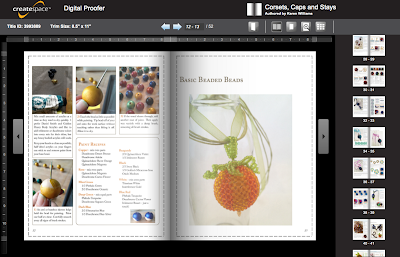 |
| Virtual proof - they even tried to simulate page turns |
 |
| I have a barcode, too! |
It's a very hands-on and project oriented, with explicit bead counts and stitching instructions. This is so different from my freeform peyote beading that I'm still vaguely stunned that I managed it. I spent an entire summer counting stitches and making diagrams!
Unlike Freeform Peyote Beading, which starts with an extensive design section, this one dives right into the stitching. The first chapter reviews the stitches - all the different aspects of single needle right angle weave used in the rest of the book, talks a little about needles and threads, and has a quickie tutorial on painting wooden beads. Then it's off into the projects.
 | |
| Chapter Head Screen shot |
So now all I have to do is wait for the books to arrive. That will be like Christmas. And a little scary too - there's that little fear, too. What have I done!?!
In the meantime, I'm working on kits for Bead Fest and to add to Etsy. I'm finally starting to get a system together and streamlining things there, too.
Tuesday, July 3, 2012
Performance, Feedback, Revision
A couple of weeks ago, my husband and I attended a Science Luminaries series lecture featuring a number of big names in the field. I'd bought the tickets for his birthday, and even managed to snag my husband the last of the VIP tickets which included a reception beforehand (I sat way up in the nosebleed seats with another friend). So now he can say he's met Stephen Hawking. Dr. Jack Horner had a fun lecture on his work to create a dinosaur (from a chicken) and Hawking's lecture was intriguing, but they're not what I'm going to talk about here today.
Instead, my brain keeps returning to the artist, Baba Brinkman, and his Rap Guide to Evolution. He performed twice during the evening, effectively opening and closing the show. His opening act(song, lecture - what do you call it?) was his Rap Guide to Evolution, which was surprisingly fun. Who knew I liked rap? But it's his last rap of the evening "Performance, Feedback, Revision" that caught me; where he links evolution to performance art to every day life.
It made me feel better to think that not only am I not the only artist whose craft is a constant work in progress, but that maybe that's actually a wholly desirable trait. I know these things, but I tend to spend so much time with revision, that sometimes it feels like that's the only thing I ever do. Especially in my written work; I'm constantly looking for better ways to describe, illustrate or photograph key ideas or techniques. When is enough enough?
And right now, I'm heavily into the revision stage. After the Seedbeader's meeting in June, I have lots of great feedback, and now I'm continuing to edit and produce my Corset & Stays Beaded bead tutorial. It currently stands at twenty pages, the title is now, Corset, Caps & Stays, and includes stub pages for a basic beaded bead using right angle weave, my Corset beads, and their evil (or not so evil) twin the Cap bead. All three are tied together so closely design & construction-wise that it seems to make sense to include them in one tutorial. I think.
Once I have a finished-looking product (see I don't say it's actually finished!) it will be time to seek more feedback by posting it for sale. My hope is to have version two done by the end of this week. Keep your fingers crossed for me!
Oh, and at the Seedbeader's meeting I discovered that many people didn't know why I called it a corset bead - it's because I stitch the middle band off of the base bead, then lace it on, just like you'd cinch a lady into her corset. So much easier than trying to stitch on the base bead itself.
 |
| Baba Brinkman performing "Performance, Feedback, Revision" |
It made me feel better to think that not only am I not the only artist whose craft is a constant work in progress, but that maybe that's actually a wholly desirable trait. I know these things, but I tend to spend so much time with revision, that sometimes it feels like that's the only thing I ever do. Especially in my written work; I'm constantly looking for better ways to describe, illustrate or photograph key ideas or techniques. When is enough enough?
 |
| there's a cap bead hiding in the right back corner |
Once I have a finished-looking product (see I don't say it's actually finished!) it will be time to seek more feedback by posting it for sale. My hope is to have version two done by the end of this week. Keep your fingers crossed for me!
Oh, and at the Seedbeader's meeting I discovered that many people didn't know why I called it a corset bead - it's because I stitch the middle band off of the base bead, then lace it on, just like you'd cinch a lady into her corset. So much easier than trying to stitch on the base bead itself.
Saturday, June 16, 2012
Still not done, but boy have I been busy

I've managed another two or three hours of stitching since Tuesday, so not a lot. I do like what's starting to happen with the curls on either end. It's about time to start working on some ruffles along the edges mid-center. The question is whether I add the poppies now or later. Placing them now will make it easier to know where I want the ruffles to frame them. But working around them will be far more difficult.

I'm in the final stages of proofing and editing a complete overhaul for my Lacework Bracelet tutorial, expanding it from eight to sixteen pages. The overhaul included replacing many of the old photographs with new, better ones, expanding and improving the section on color mixing, adding several new project notebook pages which walk through the creation process and reviewing all of the text instructions. I may also decide to replace the images on the cover.
I've included a screen shot of one of the two-page layouts below, just to give you a feel for what I'm doing with the interiors.
 | |
| 2-page spread screenshot from Lacework Bracelets |

The tutorial also includes detailed diagrams and instructions for single needle right angle weave, including decreases, two different types of increases and joins - expanding upon the free instructions from my website.
My hope is to have both available on Etsy before the end of June, with kits to follow shortly after.
Saturday, November 26, 2011
45,042 words
 |
| Just caught up with my word count this afternoon! |
The last several months have been crazy busy; putting together samples and handouts for new classes, working on several beading patterns, dealing with unexpected vacancies at my rentals, and just life in general. You know how it goes. There was an entire week early this month that I literally could not find the time to write despite my intentions to write a little every day. At my worst, the Nano stats helpfully informed me that "at this rate" I'd be finished by December 20th! Ouch!
 |
| Today's stats |
Are there other uses I could make of my time? Most certainly - I've been putting in 60+ hour work weeks for over a month now, trying to catch up. My to-do list is still about a half-mile long. Which is exactly why I'm set on carving out this time for myself. One month. Early mornings. Evenings. Weekends. Mine.
While I "won" in both 2009 and 2010, I have never actually finished a novel. In fact this is the first time I've made it past the half way point in my plot. So beyond the 50,000 goal set by Nanowrimo, I have my personal goal of finishing my entire story. Will I finish it by November 30th? Considering how much of the story is still left to tell, the jury is definitely out.
But I'll be writing fast and furiously again tomorrow, and for the next few days. The word count graph turns off at midnight on Wednesday. Just how far can I get between now and then? And if I still haven't finished my story, I'll let myself keep writing through next Sunday, because I will finish the story, as trite and ungainly and misshapen as it might be. There's something powerful about finishing a project, especially one on this scale.
To add a little pressure, I was crazy enough to sign myself up for a pitch workshop on December 7th sponsored by Createspace. And now I've told you to make it harder to back out. I'm supposed to pitch my novel to two separate editors as "part of a round table format" for new authors. Why? Because I want the experience. My fiction writing may never be publishable, but I want to know just how far I can go. And it's never a bad idea to practise presenting my ideas.
Today I wrote 6,243 words. I think that might be a personal record. My brain is pooped, so I thought I'd write a blog post. Go figure!
So my question to to you is this: what crazy artistic endeavors have you always wanted to try? And what would you need to have happen to let yourself go for it?
Monday, December 20, 2010
Oil Stick Article Reprinted

I'm a little slow sometimes, but thanks to an email from a friend, I just discovered that Quilting Arts once again reprinted my article, Working with Oil Sticks, that I wrote for the magazine back in 2004. This time, it's part of an ebook titled "Five Surface Design Techniques" that you can download for free if you sign up for their site. It was announced back in January on their blog, Quilting Daily.
As I've been seriously considering tackling oil sticks as my next major writing project, it's great to see that there's still interest in my original article. I've learned so much since then!
Thanks Margaret for pointing me towards the post. And thank you Pokey - I love to see my name in print! Maybe this will be the impetus I need to finally add a surface design gallery to my website. After the new year.
Wednesday, December 1, 2010
52,470 Words in 30 Days
 52,470 words: my final count before calling it quits last night, the last day November and night of NaNoWriMo . I'd passed the 50,000 mark; the NaNoWriMo win the night before, but pressed on because there's a LOT of story left to write, and I wanted to see just how far I could get before they called it quits and barred the gates to updates.
Waiting for me when I won; a video of the Letters and Light staff clapping and shouting 'you won' and a wide selection of winner web badges and a printable certificate. It's amazing how satisfying such simple things can be!
 Wow! During the other eleven months of the year, it's easy to forget the adrenaline rush of this event. I am definitely a geek; extreme sports hold no interest, but a hard and fast deadline for a challenging artistic endeavor; that can get my blood pumping.
Since this is my second year participating, I went back and read through some of last year's blog entries to see how the two experiences compared. One major difference stood out immediately: this time I truly enjoyed my story, not just the process. The first few days I struggled to get into the story. Returning from a week-long trip, I'd lost the flow and struggled again (raising the temptation to give up), but by the start of the fourth week, the story took on a life of its own. And from there, I won't say it was smooth sailing, but it was satisfying, even when it was a struggle. Sitting down to write, I was excited to find out 'what happened next - the particulars. Last year, by the fourth week, I hated my story and wanted to start over and only continued because I wanted to 'win'.
Like last year, I'm only halfway through the story. But with this one, there's a reasonably strong chance that I'll continue writing, though not at November's pace. But maybe, just maybe, I'll actually have something ready enough to take advantage of Createspace's free proof offer this year. (A winner goody - good through June, 2011). We'll see.... In the meantime, I'll just bask in my personal victory.
Last year, my participation in NaNoWriMo gave me both the resources (it's how I found my publisher) and courage to publish my first book. Wonder what far-reaching changes this year will bring?
Sunday, November 7, 2010
I Have the Power
Brainstorming about my writing while riding the bus last week, my secondary characters started acting in surprising ways, going in entirely new directions I hadn't envisioned during my initial plotting. As I played with what might happen and repeatedly asked the question 'how would this character react if....', the results differed significantly from other versions of the story. Trying to decide what to do, it suddenly sank in that this version is my story and I have the ultimate control. I actually laughed out loud, it was such a wonderful realization.
Up until then, I'd felt constrained by previous versions. But that's not necessary; just because characters acted one way in another version, doesn't mean they have to act that way in mine. So simple, and so powerful!
There will be similarities in plot, otherwise it wouldn't be a retelling. But HOW they react to the circumstances in which they find themselves, and even the particulars of those circumstances; those are entirely under my control. I knew this to be true for an original story, but somehow I hadn't quite believed it of a retelling.
Woo Hoo! I have the power; if I can envision it, I can try and write it. That has to be one of the major lures of becoming an author. Let's hope for clear vision!
Up until then, I'd felt constrained by previous versions. But that's not necessary; just because characters acted one way in another version, doesn't mean they have to act that way in mine. So simple, and so powerful!
There will be similarities in plot, otherwise it wouldn't be a retelling. But HOW they react to the circumstances in which they find themselves, and even the particulars of those circumstances; those are entirely under my control. I knew this to be true for an original story, but somehow I hadn't quite believed it of a retelling.
Woo Hoo! I have the power; if I can envision it, I can try and write it. That has to be one of the major lures of becoming an author. Let's hope for clear vision!
Sunday, October 31, 2010
NaNoWriMo T Minus One and Counting
 Gentle (and not so gentle) writers, rev your engines: NaNoWriMo starts tomorrow. NaNoWriMo challenges you, me and everyone crazy enough to take part to write a 50,000 word novel in the space of 30 days. That breaks down to a 'measly' 1,667 words per day.
Last year, I topped out at around 60,000 words. My half-finished novel boasted a plot that was slipperier than a greased pig with holes the size of Lake Michigan. It was an ugly, deformed little baby. But it was my baby. And I did it. Just by the act of writing, I learned a lot.
Last year's participation in NaNoWriMo led almost directly to this year's published book. While I didn't start work on Freeform Peyote Beading until January of 2010, NaNoWriMo is how I first learned of Createspace.com and their printing options, including full-color interiors. And it's where I developed the confidence to tackle the challenge of producing a full-length book. It may be a while before my novel-writing skills are up to the task, but a technical book was just the right speed.
Last year I attempted a fantasy adventure with world-building and the works. This year, I'm going for something different. Like many authors these days, I've decided to try my hand at retelling a classic fairy tale with a twist. I've settled on Beauty and the Beast, and my question is what would happen to the story if the roles were reversed? If the Beast were a woman, and 'Beauty' a man?
Subscribe to:
Posts (Atom)