Studio Musings

Showing posts with label publishing. Show all posts

Wednesday, April 29, 2015

Lessons Learned: Family Photos vs Submission Photos

In my last post in this series, I talked about what I'd learned about submitting work from the "other side of the table", running a call for entry.  In that post, I spoke in general terms.  With her gracious permission, in this post I'm going to share the process Mary Foyes and I went through to include her piece. 

Mary's family photo of the veil she created for her daughter
It all started with a Facebook message asking if I'd be interested in including a freeform peyote first holy communion veil in my book.  Mary wasn't sure if I'd be interested because it wasn't 'jewelry', but sent a picture along, just in case.  That fact that it wasn't typical jewelry intrigued me, so I wrote back and asked if she had any other photos of the veil itself.

She promised to send some additional pictures that evening.


While these photos would likely be fine for personal use, there was no way I could use them in my book.  Mary's greatest concern was that I wouldn't be interested in her work because this was a 'beginner' piece.  That concerned me far less than the issues with the fuzzy carpet and the yellow color cast (not to mention file size, slight blurriness and image resolution issues). 

I liked that it was a wonderfully approachable example of 'thinking outside the box' in terms of what you can use bead weaving for.  Beyond that, it was one of only a couple of submissions I'd received that were stitched along the width (a less common technique than stitching along the length).  

At this point I knew that I wanted to include Mary's veil, but couldn't use the photos I'd received.

A side note here; I'm not a major publisher, with a streamlined submission process receiving hundreds of submissions.  Rather, I see myself as first and foremost an advocate for freeform peyote and for the other artists working in the field.  So I put on my thinking cap to come up with ways I could help her improve her photography. 


After a morning's research, I put together my next email.  I'm including the text here so you can see my process:

"I need high quality shots of your bead work on a completely neutral or complimentary background.  By complimentary, I mean something that seems to fit with the idea of First Holy Communion (think white, gold, soft lace, old prayer books, etc.) Alternately, you could take the shots on a live model, or even a larger doll if you wanted, but be careful of the backgrounds even then.  

I just did a little research on Etsy, and here's a shop that might give you some ideas:
Made4YouBoutique uses large dolls to showcase their headbands

Made4YouBoutique,  This listing shows a nice example of using a large doll as a model.
I really like the background in this listing.  The background is in such soft focus it becomes simply a color wash, but you'd need to make sure the beads are in crisp focus.  This is a depth of field issue, if your niece is a camera aficionado.
In this listing, I like the headband shown against the decorative paper backgrounds.  A trick I've learned when using decorative paper as a background - it the print seems too strong for a background, cover it with a layer or two of tissue to soften it.  Does that make sense?  I am not as fond of the wood backgrounds as they don't seem to say anything about the piece.


ButterCreamDolls spectacular photography makes me wish I had a little girl to buy for

Here's a shot from a different store (), on a real little girl.

I couldn't find the shop name when I went back while writing this post
And I like this shot from a third shop.  Also on a real girl, The focus is very much on the veil.  I could see your freeform band showing up beautifully in a shot like this.  And your daughter might enjoy having such a shot for her scrapbook, too.


I highly recommend using Etsy, Pinterest or other sites heavy on photography to get ideas for how to set up your photo shoots.  Look at background, lighting, how they display their items and which seem most appealing to you.


I'd like both some closeup (detail) shots, and a shot or two from a greater distance showing more of the veil and giving me room to crop the photo as necessary to fit my page layout.  Because the focus here is your freeform, the flower at the back of the veil isn't as important, but it's nice to see some portion of the veil itself to make it clear what it is."

Mary promised me new photos.   A couple of weeks later, these are what I received:

photography by Shauna Ploeger, Photography Du Jour

photography by Shauna Ploeger, Photography Du Jour
Mary decided to work with a professional photographer, Shauna Ploeger, of Photography Du Jour.  Shauna took a number of different shots, of which I've included three.  Gorgeous!  I loved that she included both horizontal and vertical versions of each shot.  This gave me tremendous flexibility when it came to page layout and design. 

If you choose to use a professional photography, make sure that they know how you plan to use the photos!  It is very important that you get the proper licensing if you plan to submit photographs for possible publication.  As a publisher, I need to be able to use the images in a variety of ways, and I need to not have to worry about photographers becoming understandably irate over unauthorized usage of their work. 

My artist agreement contract states that "Artist grants Author a non-exclusive, non-transferrable license to use the photographic representations of the Artist’s Work(s) provided by the Artist, in print and digital formats in relation to the publication of Explorations in Freeform Peyote Beading, referred to hereafter as the Book, including publicity and promotional materials including but not limited to websites, press releases, blog posts, posters, point of sale displays, postcards, etc. related to the book."  This is a fairly standard publishing clause.  When working with a professional photographer, make sure you have the license necessary to grant these permissions.  Get it in writing.  You may have to pay more for this license. 

Whether you plan to photograph your work yourself, or hire someone to do so, researching background and display options will give you a better understanding of what you'd like the final photographic product to look like.  Back when I worked as a gallery owner, an artist once commented that his slides were more important than his actual work, because the slides were what he'd be judged on for shows, grants and almost all other professional opportunities.   That shocked me at the time, but I'm coming to understand what he meant.  The photographic records of your work can be almost as important as the works themselves, depending upon what you hope to do. 

As solo artists, we wear so many hats!  Artist, photographer, personal publicity manager - each with its separate set of skills and proficiencies. 

Wednesday, February 18, 2015

Explorations goes Digital!

Drumroll please!  Explorations in Freeform Peyote Beading, is now available as a four-volume ebook set.  I've been wrestling with the translation to ebook for over two months now, and am absolutely thrilled to announce that it now available for Kindle and ePub (which uses a range of readers including Overdrive, iBooks and Adobe Digital Editions).

File-size was the single largest factor in my decision to divide the book into four volumes for the digital edition.  As a single file, the book was simply too large, with too many images, even once I'd reformatted the images for the screen.   But my hope is that by dividing the book, it will also allow people to choose exactly the content that interests them most.  

Once I divided the book into sections, I realized that I now had the luxury of space.  With the single-column, flowing layout of ebooks, I didn't have to fit all of my information into one or two page spreads.  So I went back to the drawing board and looked through the photos I hadn't been able to include in the print version due to file size, adding them back in where it seemed appropriate.  Some of the ebooks have more additions than others, but each has at least a few new additions. 

Here's a look at the set: 

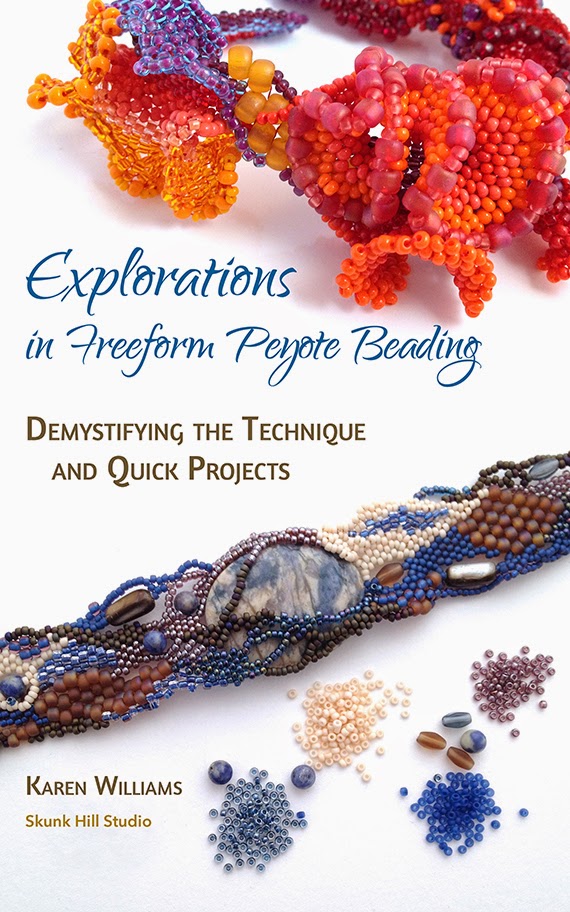
Volume 1:  Demystifying the Technique and Quick Projects (Chapters 1&2)
cover image for Chapter 1 & 2:  Demystifying the Technique and Quick Projects
I decided to combine the first two chapters into one ebook volume.  This contains most of the diagrams detailing the core stitch techniques and ideas, a look at how the elements of design can help guide your beading and lots of great, smaller projects for getting started.
 

Includes:
  • Basic Stitch Techniques: even and odd count peyote, increases, decreases and tubular peyote
  • Freeform Peyote Variations: working along the length, working along the width, building bridges, working around curves
  • Information on tools, materials and bead choices
  • Elements of Design and how they relate to freeform beadweaving: Value, Line, Texture and Working with Color
  • Photo galleries featuring additional works and ideas for expanding upon a theme
  • In-depth photo essays detail the construction process for seven pieces 
  • Personal Planets beaded beads tutorial
  • Ideas for combining freeform peyote with other media and beadweaving stitches
  • Additional works by artists Ibolya Barkóczi, Sarah Meadows, Marlene Oman Emmons, Lisa Jones, Mary Kearney, Marsha Melone, Jennifer Porter, Ellen Lambright and Bobbie Rafferty
Available on Amazon, or my Etsy Store.

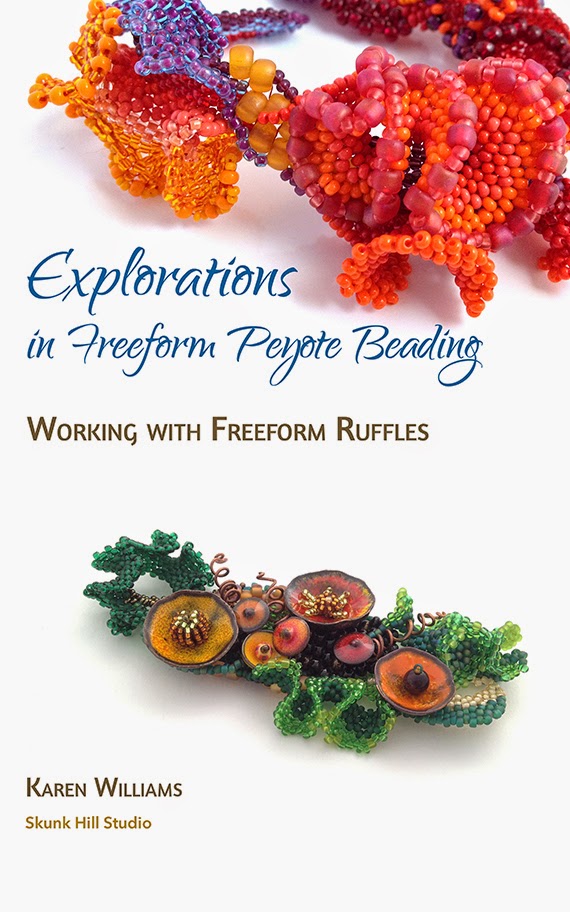
Volume 2: Working with Ruffles (Chapter 3)
cover image for ebook Volume 2: Working with Ruffles (Chapter 3 from print edition)
Volume Two covers one of my favorite topics - freeform peyote ruffles! The chapter starts out with a series or ruffle experiments showing how slight changes in bead counts can create significant differences in appearance of the finished ruffles.  From there, I dive into a series of projects using ruffles, including earrings, pendants, brooches and cuffs, finishing with a look at the softer freeform ruffles of my first featured artist, Jennifer Porter.  

Includes:
  • Three Ruffle Experiment photo essays show how stitch choices affect ruffle development
  • Detailed photo essays share the design and construction process for five original pieces
  • How the author developed the basic stitch techniques into series of related, but unique designs
  • How to incorporate larger accent beads into freeform ruffle designs
  • Developing a design around unique focal items, in this case enameled poppies and headpins
  • How to incorporate the ruffles into larger projects with the Coral Dancer bracelet and Fallen Leaves cuff
  • Works by featured artist, Jennifer Porter
Available on Amazon, or my Etsy Store.

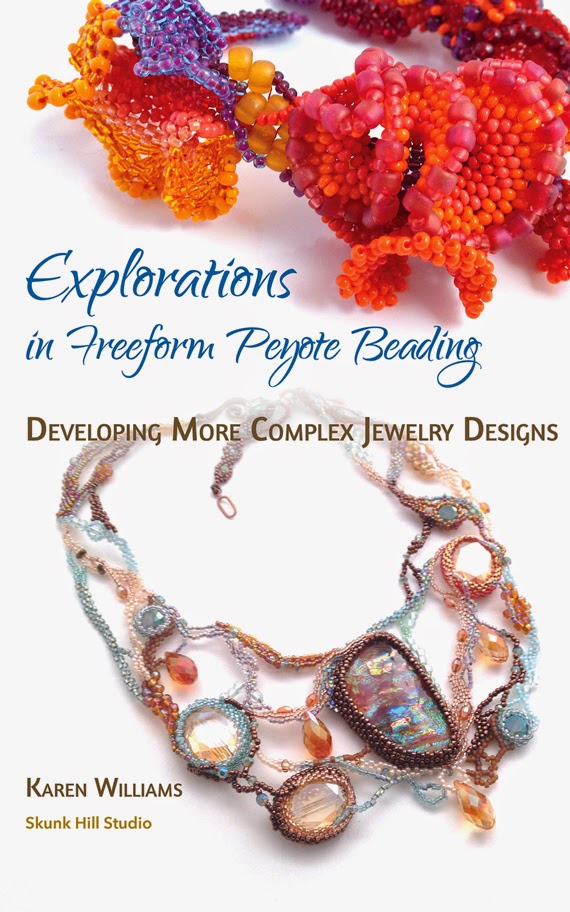
Volume 3: Developing More Complex Jewelry Designs (Chapter 4)
cover image from ebook Volume 3: Developing More Complex Jewelry Designs (Chapter 4 from print edition)
While I lightly touched on larger project such as bracelets and necklaces in the earlier chapters, here these designs become our primary focus.  This chapter/volume is like a master class with an in-depth look at the design and creation process of myself and four extremely talented artists from around the world.  

Includes:
  • In-depth photo essays detailing the construction process for five of Karen’s original designs.
  • A closer look at the works of four featured artists from three continents:  Natalia Malysheva, Cynthia Machata, Wendy Hatton and Janice Cuozzo
  • Design tips for using paper mockups and simple sketches to test fit and design suitability before begin to stitch
  • Troubleshooting suggestions to help salvage recalcitrant designs
  • Additional works by Sherry Eagle, Liz Hart, Bobbie Rafferty, Mary Foyes, Mandi Ainsworth and Ibolya Barkóczi\
  • Note - this chapter does not include beading diagrams or instructions on the basic stitches, and is best suited for beaders already comfortable with peyote stitch, including increases and decreases.  

Available on Amazon, or my Etsy Store.

 Volume 4: Beaded Forms and Freeform Sculpture (
Chapter 5)
cover image from ebook Volume 4: Beaded Forms and Freeform Sculpture ( Chapter 5 from print edition)
An introduction to the range of possibilities using freeform peyote as a sculptural medium.  Trying to find a way to encapsulate and summarize this chapter, most simply it introduces two distinct modes of sculpture - covered shapes and hollow forms.  Rather than trying to create a comprehensive look at all of the sculptural possibilities, I focused on areas of personal interest. 

Includes:
  • In-depth photo essays detailing the construction process for two Beaded Bottles
  • Tips and suggestions for working with armatures and beading around a form
  • Ideas for creating smaller, sea-based sculptures including barnacles, anemones and nudibranches
  • Featured artist, Nancy Dale’s detailed tutorial on creating Beaded Rocks expands the concept of encapsulating forms with freeform peyote
  • A closer look at the freeform Beaded Fish of featured artist Georgia McMillan, with a detailed tutorial by Karen Williams  
  • Additional works by Cortney Phillips and Beth McGowan
  • Note - this chapter does not include beading diagrams or instructions on the basic stitches, and is best suited for beaders already comfortable with peyote stitch, including increases and decreases.

Available on Amazon, or my Etsy Store.


The listings  through my Etsy store includes an immediate download for the ePub (.epub) formats. If you'd also like the Kindle version, write "Kindle" in the Directions to Sellers section of your purchase and I will send a link to download the Kindle version within 48 hours.  Unfortunately, the Kindle files are too large to upload to Etsy for direct download (file sizes again!), so this is the best work around I've been able to come up with for now. 

Wow!  What a year this has been.  Explorations may have been my third book, but was definitely a learning experience every step of the way, building upon everything that came before.  Having never published for Kindle or ePub, I had no idea what I was getting into.  But I am truly pleased with the results. 

Saturday, November 29, 2014

Books Are Here!

 Not one, not two, but four BIG boxes of books have arrived! Explorations in Freeform Peyote Beading is now published! 

boxes of books for Explorations in Freeform Peyote Beading

I was almost afraid to open the boxes.  What if I'd overlooked some terrible error in my final document files?  What if the books had all been damaged in shipping?  What if they weren't actually my book?  (okay, I was pretty sure that last one wouldn't be the case, but....)


After a series of deep breaths, I dared myself to open and unpack the boxes.  Here's what they looked like unpacked:


But a friend who watched me unpack the books said this picture was too boring.  So she made me pose with the books:


Can you can guess what I'll be working on this next week?

Actually, I'll be splitting my time between signing books and putting together packages, and continuing to work on the Kindle version of the book, (which is turning out to be every bit as difficult as I'd feared).

If you're interested, I have a very limited number of signed copies available on my Etsy store.  This first order is most of the books are already spoken for.  I will be placing another order, but likely won't have those books in until January.  Budget constraints - sigh!

As a special thank you for still following my poor, neglected blog; if you purchase my book through Etsy, write 'Congratulations Karen' in the notes to seller.  Do that and I'll include a set of five randomly chosen postcards featuring works from the book along with your book.


Just a heads up - Ordering directly through Amazon may be a less expensive option.  Because Createspace (my printer) is one of their subsidiaries and Amazon ships books in such volumes; they may be able to offer discounts that I simply can't.  Explorations should be live on Amazon by Monday. (12/2/2014 update:  Here is the link to Amazon).  But only I can offer personalized inscriptions and postcards!

This Thanksgiving weekend, I have an incredible amount to be thankful for.  I am grateful for my Kickstarter supporters who believed in this project from the beginning.  For my dear husband who led the cheerleading squad and cooked many a dinner when I was simply too tired.  For all of you, my blogging friends, who have sent me much needed words of encouragement throughout the process.  And I am so very, very pleased to be able to announce that the books are complete.  Amazing!

Thank you all for your part in helping make this happen.


Friday, March 14, 2014

Would you like to see your work in print?

Would you like to see one of your freeform peyote beading pieces in a book?  I'm still accepting submissions for inclusion in my upcoming book, Explorations in Freeform Peyote Beading.

What I'm looking for are original designs, high-quality photos and a wide range of styles.  The predominant beading style of all work submitted for consideration must be freeform peyote, though pieces may include other beading styles, stitches and media.  Works may be jewelry, accessories or small sculptural pieces.  This is open to all artists both within the United States and abroad.

The deadline is March 31st 2014, which is fast approaching.

I'm looking for both finished pieces and for artists willing to show a peak into their process.  Here's the skinny:

Finished Works
I need finished pieces to help showcase the breadth and depth of the medium and to help illustrate specific design and construction techniques.  I'm looking for both Rock Star stand-out pieces and good solid samples of freeform peyote design. 

If I use your work, the caption will include the your name (and your photographer’s name, if different) and the title of your piece.  I will also include your name and the title of your piece in an index of photographs, with a link/URL to your website, blog or estore (limit one URL).  In addition, each artist will receive a digital copy of the completed book.

Share Your Process & Become a Featured Artist
My goal here is to show how other artists tackle the construction and design process.  Besides photographs of the finished piece, I'm also looking for several process photos illustrating the key points in helping someone else understand what you are doing.  A photograph of your source of inspiration or any design sketches is also welcome.  Include some written commentary explaining your process and process photos (2-3 paragraphs). 

If you are chosen as one of my featured artists, you will receive a print copy of the finished book and a $50 token of appreciation for your contribution. 


Interested in Submitting a Piece?  
Read through the general guidelines below

Please use my Submission Form!   I am not trying to be contrary here, but it helps insure that I receive all of the information I need and keeps all of the information in one place so I don't accidentally lose track of what you have submitted.

Due to upload limitations, the maximum file size for each image is 3MB, with a maximum of three images per entry.  You may submit up to two Call for Entry applications if you would like to submit more than three images. Please let me know if you have larger or other versions of your photographs available. 

General Guidelines
Copyright:  Only submit work for which you are wholely responsible for both the design and construction.  If your work was inspired by the work of another artist, please include the name of the artist and their work, explaining how it acted as your inspiration.

Works submitted for consideration should be relatively new, produced within the past three years, preferably that has not been published in any other print format, to avoid potential licensing infringements.  If your work has been reproduced in another book or magazine, you must let me know where as there may be copyright/licensing issues involved.  If your work has appeared on a blog or other digital format, please let me know this as well (including URLs where available) and whether it was that particular photograph that was used for the site.

Licensing: If your work is accepted into this project, you agree not to publish your work in any other format (including your personal blog and social media pages) until the publication date of the book, or December 31, 2014 if the book has not yet been released.  You retain all rights to your photograph and to the original work.  You grant Karen Williams and Skunk Hill Studio the right to reproduce photographs of your work in print and digital formats, including publicity materials (websites, press releases, blog posts, postcards, etc) related to the book.

Image Format & Sizes:  Images may be submitted as .JPG or .PNG.  Minimum file size (1500x2000pixels), Maximum file size 3MB (3072KB).  If your image is selected for inclusion, I may contact you to see if it is available in a larger format.


Photography Tips:
Backgrounds: Keep the background simple and appropriate for the piece.  Neutral backgrounds - white or black - work really well so long as they read as white or black in the photograph (whites that look yellow are hard to correct without losing color details in the piece, for instance).  More detailed backgrounds can also work, so long as they help tell the story of the piece without overwhelming it.  A fantastic guide to taking great photos is The Crafter's Guide to Taking Great Photos by Heidi Adnum (I wrote a more detailed review here).

Color:  Make sure the photo is as close to true color as possible!  If you are submitting multiple shots of the same piece, make sure that the colors remain consistent between photos.

Focus:  I can't stress this one enough!  The focal point of your photograph must be crystal clear.  I want people to be able to see individual beads.  If you're photographing a larger work, such as a necklace, the entire piece may not be in focus due to depth of field issues.  This is okay so long as the most important part of your piece is in crystal focus. 

Process photos - it's extremely important that these be on a solid, neutral background (white, grey, cream or black).   I take process photos on my bead mat which has a very fine texture - that's fine so long as it comes across as subtle texture and not wear.  It's okay to have stray beads mat, so long as they don't interfere with the viewers ability to see the photo's focus.   Watch out for stray pet fur, lint and other stray bits though. 

In taking process photos, try to come up with the key points in helping someone else understand what you are doing.

Any questions?  Let me know!  I look forward to hearing from you.  

Friday, January 24, 2014

Call for Entry - Now Accepting Submissions

This is a call for entry for my upcoming book Explorations in Freeform Peyote Beading: Designing Original Art Jewelry and Beyond.

What I'm looking for are original designs, high-quality photos and a wide range of styles.  The predominant beading style of all work submitted for consideration must be freeform peyote, though pieces may include other beading styles, stitches and media.  Works may be jewelry, accessories or small sculptural pieces.  The Call for Entry is open to all artists, whether within the United States or international.

There will be two levels of participation: 

A) Images of Works - One to two images per artist.  I will use these pieces to help illustrate specific design or construction elements and/or in gallery pages.  The caption will include the artist’s name (and photographer’s name, if different) and the title of the piece.

The artists and their works will be listed in an index of photographs, with a link/URL to their website, blog or estore.  In addition, each artist will receive a digital copy of the completed book.

B) Featured Artists - Here, I'm looking for artists willing to share information about their creative process as well as their finished piece.  The goal is a quick peek into your process, including two to four progress photos and your source of inspiration as well as the finished piece along with some commentary about your process.

The featured artists and their works will be listed in an index of photographs, with a link/URL to their website, blog or estore and will have a short biographical statement associated with their work.  In addition, these artists will receive a print copy of the finished book and a $50 token of appreciation for their contribution.

Requirements 


Copyright:  All work must be submitted by the artist who designed and stitched the piece.  You must hold the copyright to the design.  If your work was inspired by the work of another artist, please include the name of the artist and their work, explaining how it acted as your inspiration.

Works submitted for consideration should be relatively new, produced within the past three years, preferably that has not been published in any other print format, to avoid potential licensing infringements.  If your work has been reproduced in another book or magazine, you must let me know where as there may be copyright/licensing issues involved.  If your work has appeared on a blog or other digital format, please let me know this as well (including URLs where available) and whether it was that particular photograph that was used for the site.

Licensing: If your work is accepted into this project, you agree not to publish your work in any other format (including your personal blog and social media pages) until the publication date of the book, or December 31, 2014 if the book has not yet been released.  You retain all rights to your photograph and to the original work.  You grant Karen Williams and Skunk Hill Studio the right to reproduce photographs of your work in print and digital formats, including publicity materials (websites, press releases, blog posts, postcards, etc) related to the book.

Image Format & Sizes:  Images may be submitted as .JPG or .PNG.  Minimum file size (1500x2000pixels), Maximum file size 3MB (3072KB).  If your image is selected for inclusion, I may contact you to see if it is available in a larger format.

Photography Hints:  I am looking for the highest quality images as well as the highest quality work.  If you're looking for tips and hints to improve your photography, I highly recommend The Crafter's Guide to Taking Great Photos by Heidi Adnum.  Remember to keep backgrounds simple - the focus should be on your jewelry.

Deadline:  The deadline to apply is Monday, March 31st.  I will be selecting work for inclusion in my book project in an ongoing process throughout the application period.

Kickstarter

I'm Seeking Backers for this Project


I'm running a Kickstarter campaign to help crowdfund and support the production of this book.  Right now my budget is very slim, meaning I will need to keep the number of external artists (especially featured artists) low.

More artists means a broader range of ideas and inspiration as every artist has their own style and method of working.  Your support and a successful Kickstarter will allow me to greatly expand the number of artists’ whose work is included in the book.


Submitting your work:


Click here for the official submission form

If you you would like to be considered as a featured artist, make sure to include at least one work-in-progress image and indicate your interest in the additional information section.

I am using an EmailMeForm account to standardize data collection.  Due to upload limitations, the maximum file size for each image is 3MB, with a maximum of three images per entry.  You may submit up to two Call for Entry applications if you would like to submit more than three images. 

Any questions?  Let me know! 


Wednesday, January 15, 2014

Three, Two, One..... Launch


I've just launched my Kickstarter campaign for my next book, Explorations in Freeform Peyote Beading!

For those of you not familiar with Kickstarter, it's a form of crowd funding, connecting people with ideas with people who like those ideas enough to want to help make them happen.  Kickstarter provides the basic tools, framework and online venue for the fundraising.  The person with the idea takes it from there, reaching out to the world and saying "wouldn't it be cool if...".  If she's lucky and really does have a great idea, the community and the world agrees, her campaign is funded, and she gets to work turning her idea into something real. 

My idea:  a new book entitled Explorations in Freeform Peyote Beading: Designing Original Art Jewelry and Beyond.  

Reaching out to the World:  This will be my second book on freeform peyote beading.   Why have I decided to crowd fund this book, when I've self-funded both of my previous endeavors?  The answer is simple - I don't want to compromise this time around.  With Freeform Peyote Beading, I had to make some really hard choices in order to get it to publication.  Decisions that meant information was left on the cutting floor because I simply couldn't afford to include them based on the additional time it would take to flesh them out. 

I am still so proud of Freeform Peyote Beading - I stayed true to the core of the idea of what I wanted to present and I still believe it's an excellent introduction to freeform peyote beading.

With your support, Explorations can go the next step, continuing to bring this compelling, fascinating and challenging medium front and center.  I may be the one writing and producing this book, but the truth is, it's not my book, but yours.  I'm writing it for you and others like you who are interested in the same crazy beading that I am.  So we can all create our own wonderfully original freeform designs.

Curious what I have planned?  Wander on over to Kickstarter and check it out!  You can even watch a little video where you'll see (and hear) me talk about the project.  No worries about me abandoning writing for a film career though - I'm definitely a much better writer and author than I am videographer! 

And if you like my ideas, please consider becoming a part of this project.  I'd love to share this process of creation with you, and give you the tools to make your creative visions a reality.


Wednesday, January 1, 2014

New Year's Plans - a New Take on Freeform Peyote Beading

It's time to write the sequel to Freeform Peyote Beading!

My first book, Freeform Peyote Beading was totally a labor of love, born out of the belief that there must be others, somewhere, interested in the same crazy beading that I was.  When I began that project there were no other books out in the field.  Writing Freeform Peyote Beading I worked in largely uncharted territory, deciding what were the most essential elements necessary to be successful in this medium.  I know there have been comments that my book could have been more.  I have to agree - even then there was so much more I wanted to add.  But in the interest of actually completing the project, I decided it was 'enough to be getting on with' as one of my friends would say. 

In the past four years, my comfort and skills with the entire writing/editing and publishing process have grown tremendously.  Better yet, I'm now part of a community of individuals from around the world interested in beadweaving in general and freeform beading in specific.  And I know I'm not totally bonkers thinking that someone, somewhere might also be interested in my finished book.

So, after much thinking and plotting and planning through the second half of last year, I decided that 2014 is the time to create a new and improved version of Freeform Peyote Beading.  I committed to that first project on January 1 of 2010, so it seems only fitting that I announce my intentions to create it's sequel here on my blog on the first day of 2014.  Some of you may have seen my comment in the Freeform Peyote Beading group, but here's the formal (at least as formal as I tend to get) announcement:

The new book will be:

Larger and Longer  The new book will be a full 8 1/2 x 11” paperback topping out at 150 pages - nearly twice the length of my original!

Full-bleed photography  The full-color interior layout will include full-bleed photographs allowing me to expand the images all the way to the edges of the page. 

More Designs, More Artwork, New Projects Most of the additional pages will be devoted to more and expanded beading examples and more in-depth tutorials with new designs.

Works by Other Artists  I am in awe of the wonderfully vibrant community of artists working in this medium and hope to include and promote other artists through the medium of my book.  As such, I am and will be actively soliciting participation through a Call for Artists.   While I plan to post a Call for Artists here on my blog, let me know if you’d like to receive an email notification when it goes live.  

Not Just Jewelry  I'm adding a completely new chapter entitled “Beyond Jewelry” which will focus on freeform beading as a sculptural medium, including beading over ready made forms such as glass bottles and free-standing sculptures.

Index Amongst other things, I'm currently at work developing a list of keywords and phrases for a comprehensive index to make finding information even easier. 

Digital Publishing I am also hoping to publish in both Kindle and PDF digital versions as well.

Expected publication date: December 2014.  My plan is to have it available on Amazon by or before December 1st.

It's a long journey between here and there, with many, many steps.  To help guide me on my way, I have my detailed outline along with my somewhat daunting production plan with deadlines for each element of writing, beading, photography, illustration, editing, page layout and more.  And I'm ready to start.  Excited, a little scared, part of me wondering what in the world I'm doing, but excited to dig in.

Is there something in particular you'd really love to see in the book?  Now's the time to let me know!  I'd love to hear your suggestions.  

On January 15th, I'll be launching a Kickstarter campaign to continue building a community of supporters and to help me fund this project.  In a project of this scale, community is so important.  I want to continue to show the world what Freeform Peyote is all about and share some of the best and brightest from our community in the pages of my book.  It will also be great to have that financial support while I work on a project of this size. 

With this great new book project and my first Kickstarter, 2014 looks like it will be a fantastic year and here's wishing that yours will be just as wonderful!

Happy New Year!

Monday, December 20, 2010

Oil Stick Article Reprinted


I'm a little slow sometimes, but thanks to an email from a friend, I just discovered that Quilting Arts once again reprinted my article, Working with Oil Sticks, that I wrote for the magazine back in 2004. This time, it's part of an ebook titled "Five Surface Design Techniques" that you can download for free if you sign up for their site. It was announced back in January on their blog, Quilting Daily.

As I've been seriously considering tackling oil sticks as my next major writing project, it's great to see that there's still interest in my original article. I've learned so much since then!

Thanks Margaret for pointing me towards the post. And thank you Pokey - I love to see my name in print! Maybe this will be the impetus I need to finally add a surface design gallery to my website. After the new year.